Where did you grow up, and what first got you interested in studying theology and ministry?
I grew up in Minneapolis, where the Black Church was central to my family life and formation. My great-uncle was my pastor for the first 20 years of my life and a key leader in Minnesota’s Black church community. Much of what I know and believe about being a Christian was shaped by his influence. When I was eight years old, I told him that I wanted to be a preacher just like him.
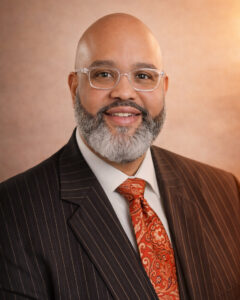
I am a seventh-generation minister on my mother’s side of the family. As I grew older, however, I did not want to enter ministry simply because it was part of my family tradition or because others expected it of me. I wanted to answer the call with a pure heart and sincere motives. And so I ran from it for years.
After relocating to Charlotte, North Carolina, I became a member of the Park Church, where much of my spiritual healing occurred. This community became a safe place for me to ask questions about faith that I had been afraid to ask for much of my life. Bishop Alexander’s preaching, teaching, and leadership helped me understand that serious questions do not weaken faith—they can deepen it.
In 2024, I experienced a life-threatening medical crisis and spent three and a half weeks in a coma. When I awoke, my call to the ministry became much clearer. During my recovery, I surrendered to God’s plan for my life. That does not mean life is now free of real problems, but walking in the Lord’s guidance has been amazing.
What did you study as an undergraduate, and where did you go?
I began my undergraduate studies as a Mortuary Science major, completing most of my early coursework at Mankato State University—now Minnesota State University, Mankato—and the University of Minnesota. After relocating to North Carolina, I completed my undergraduate degree in business management from Montreat College.
What led you to pursue theological education at Luther Seminary?
I am not entirely sure how I found my way to Luther Seminary, or perhaps how Luther found its way to me. Having grown up in the Minneapolis–Saint Paul area, I had known about Luther and several other local seminaries for most of my life. After moving back to Minnesota, I casually explored seminary programs online and began receiving information from several schools. Luther stood out. The Jubilee Scholarship made attending seminary not only more attractive but also realistic and accessible.
What began as a tentative exploration has become an important part of my formation. I love being a member of the Luther Seminary family, and I believe I am exactly where I am supposed to be in this season of my life.
What are you hoping to do with your seminary education?
I am pursuing a Master of Divinity degree at Luther Seminary. I am not completely sure where I will land after that and am comfortable admitting this. I am following God’s lead, and God has already revealed possibilities for my life and ministry that are greater than anything I previously imagined. I may not know the exact destination yet, but I know that my seminary education is preparing me to serve wherever God leads.
What has your student experience been like?
I am a residential learner and currently live on campus in Luther’s graduate learning community. My student experience has extended well beyond the classroom. I served on student council, where I had the opportunity to represent my fellow students and contribute to conversations about accessibility, engagement, and belonging.
What do you do when you’re not studying?
Outside of Luther, I participate in several community-engagement programs through my fraternity, Kappa Alpha Psi Fraternity. I also provide consulting services to churches, nonprofit organizations, and small businesses. Entrepreneurship is another of my passions, particularly when I can use my experience to help an organization clarify its mission and strengthen its impact. When I am not studying, writing, consulting, or serving, I enjoy live music and football.
Most of all, I enjoy connecting with people. I have discovered that when we give one another enough time, we almost always find something we share. That common ground can become the beginning of deeper and more meaningful relationships.
What is one thing people might not know about you?
I began working at a local funeral home when I was 15 years old and remained in the funeral industry throughout college. Over the years, I learned nearly every aspect of funeral-home service, from responding to the initial call through helping families make arrangements, preparing the deceased, coordinating transportation, and assisting with funeral services and graveside committals.
The most meaningful part of that work was caring for grieving families during some of the most painful moments of their lives. Looking back, I believe those years helped develop my pastoral-care instincts long before I knew I would one day study pastoral care in a seminary context.