Where did you grow up, and what first got you interested in studying theology and ministry?
I grew up in a multigenerational household in the Sandhills region of North Carolina. The community where I lived was small, tight-knit, and well-segregated. Church was a focal point of our collective upbringing. My church had services only on the first and third Sundays of the month, so we visited other churches within the community on the second and fourth Sundays, making for a real communal experience as some of the other churches were different denominations. My grandparents were leaders in the church (head deacon and head mother) so my siblings and first cousins spent a lot of time taking part in the custodial and communal duties of the church. Those duties included cleaning the church on Saturdays in preparation for Sunday service, properly cleaning and storing the sacraments, singing in the choir, attending Sunday school and worship service on Sundays, and Bible study and prayer meeting throughout the week. We made the rounds to all churches in the community during the summer for Vacation Bible School and did the same thing for Easter every spring. If the church doors were open, we were there. Our church work was our service.
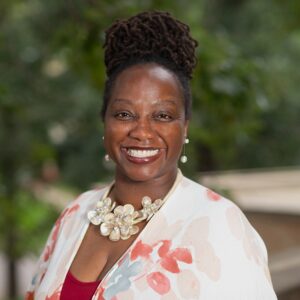
I first became interested in ministry when I left North Carolina in 2004 to take a job in Minnesota. Our pastor at the time—Elder William McKay—prayed for me and spoke a word over my life that I still reflect on to this day. That word foretold a vision of the ministry God was calling me to. Up to that point, I was convinced that my ministry was going to be as a gospel singer. My interest in studying theology came last year. Once it was clear that I was ready to act on a word God shared with me over 20 years ago, I knew I needed to be a student of the Word to most effectively proclaim and apply the Word. Although ministers in my faith tradition (Baptist) aren’t required to have a degree in order to serve as ministers or pastors, as an educator, it is important to me.
What did you study as an undergraduate and where did you go?
I earned my BA in Elementary Education and my MA in Educational Technology on the sloping hills and verdant green of North Carolina Central University (NCCU), an HBCU (Historically Black College or University). This distinction matters as it provided an immense sense of belonging in a racialized society and an inequitable education system. At NCCU, I was exposed to the diversity of Black culture from a majority lens as opposed to a minority one.
What led you to pursuing theological education here at Luther Seminary?
A few years ago, I was participating in a corporate annual fast as I was also seeking direction about where to pursue my M.Div. I wanted to be in a learning environment that challenged my traditional upbringing, prioritized diversity, and prepared me to engage in the work and ministry of liberation through social justice movements. I had settled on my top three seminaries and begun the information gathering process. I shared with a friend—Michelle Edgerton ’24 M.Div.—that I was applying to seminary and she asked if I had considered Luther Seminary. My friend enlightened me through her experience and explained that Luther was open to students from all faith traditions. She encouraged me to visit Luther’s website. When I did, I read the ABIDE statement and read about Luther’s value of making sure finances do not serve as a barrier to ministry—I knew then that Luther Seminary was the answer I had been seeking.
What has your student experience as a distributed learner been like?
My student experience has been better than expected. I am accustomed to being a part of yearlong leadership cohorts that include a one-week residency and online meetings in between. I wasn’t prepared for how impactful Luther’s RFS (residential focus sessions) were going to be. I found myself quickly making connections with some of my peers. I miss my in-person peers so much that when I travel to Minnesota to visit family, I visit them on campus. During my first RFS, I served as an assistant minister during chapel and met other students. I invited one of my friends who lives in Minnesota to tour the campus with me and attend an event related to the Smithsonian Origins exhibit.
What do you do—professionally and otherwise—when you’re not studying?
When I’m not studying, I am cheering on my spouse, who is a marathoner, providing respite for children in foster care, supporting those on grief journeys as a GriefShare facilitator, making a joyful noise as a gospel choir member, working as a full-time employee, and supporting others in the public education sector as they engage in their own leadership development work.
What’s one thing people don’t know about you?
Many people don’t know that I have completed seven half marathons. My first one was in Wausau, Wisconsin.