Where did you grow up, and what first got you interested in studying theology and ministry?
I grew up in Harrisburg, North Carolina, near Concord and Charlotte. I went to middle school and high school in Concord, and our church was in Charlotte. I was raised in the Southern Baptist tradition, and my mother was a Southern Baptist minister prior to the early 2000s.
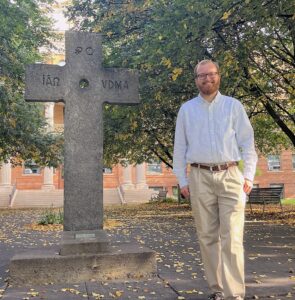
I have had an interest in theology for a long time. I think this interest has its roots in my youth Sunday School class. The class was taught by two teachers, both of whom highly valued our ability to form and articulate our theological positions—even when we disagreed with them. In the context of this class, I started to question the church, especially the baptismal doctrine of my church. My childhood church believed that we are saved by faith. However, since the church believed that some people are too young to have faith—no baptizing infants—they also taught that before a certain point in your life you would be saved without faith since you were physically unable to have faith. In my study of the Bible in Sunday School, I was unable to find a biblical justification for the claim that children could be saved without faith and was unable to find a justification for denying the existence of the faith of young children in my daily life. This is what really launched my interest in theology, by providing the theological puzzle that would ultimately lead me to Lutheranism.
My interest in ministry started in college. I began my schooling with intentions of becoming either a lawyer or a professor. At the same time I became very active in lay leadership at my church and campus ministry. At this time God began to call me further into ministry. I fought this call by attempting to negotiate God down into more volunteering—I figured I could just keep at lay leadership. Others definitely realized the call before I did. My campus ministry and fellow lay leaders encouraged me to seek Word and Sacrament ministry. Finally, I gave in and began the candidacy process with the North Carolina Synod of the ELCA.
What did you study as an undergraduate and where did you go?
I studied at UNC Greensboro in North Carolina, and have a major in History and a minor in Classical Studies.
What led you to pursuing theological education here at Luther Seminary?
I was led to Luther after having already been accepted into my first and second choice schools. I had not even considered moving to Minnesota but realized in the weeks following receiving my acceptance emails that I was looking at the wrong schools. I went back to the drawing board and, knowing I wanted a larger school with a residential community and stability of size, looked first at Luther. On our website I quickly ran into our mission statement: “Luther Seminary educates leaders for Christian communities called and sent by the Holy Spirit to witness to salvation through Jesus Christ and to serve in God’s world.” I was encouraged and intrigued by the mission statement and decided to begin the application process. In about two weeks I was in Minnesota for a very cold campus visit day with my grandfather. An aunt says I made my decision before I even finished the application to Luther, and I think God was definitely working in bringing me to Luther Seminary.
What has your residential student experience been like, and what do you do—professionally and otherwise—when you’re not studying?
I love the vibrant residential community here at Luther. Moving across the country has been much easier because of all of the wonderful classmates and fellow residents I have had. When I am not studying, I am active in the residential community here on campus—going to movie nights, sharing meals, and so on.
How would you describe the value of Luther Seminary’s strength as an academic institution?
Entering seminary, I really wanted to get a solid education as well as create long lasting friendships with other people entering into ministry work. Luther’s strengths in this regard lie in the vitality of our community and the strength of our faculty. Our community creates opportunities to build relationships with Christian public leaders from all over the country and world. Luther is blessed with a very capable faculty and has already been teaching me and pushing me to be better equipped as a Christian public leader.
What’s your hidden talent?
I love cooking, I find it very relaxing to cook. It gives me something to do physically that uses just the right amount of mental effort to take my mind off of anything that is troubling me and not so much effort that it is stressful.